Physical AI and Robot Safety: What Businesses Must Design Before Deployment
Plan physical AI safely with bounded tasks, simulation, layered engineering controls, human factors and measurable evidence from pilot to production.
By AUZtec Innovations
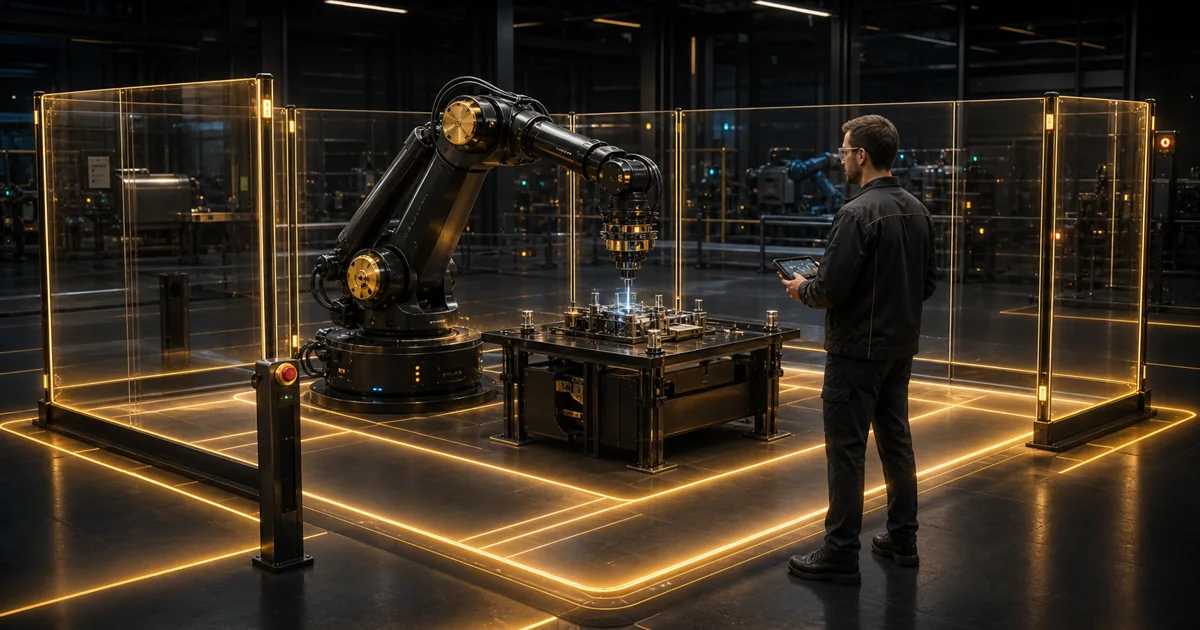
Physical AI combines learned perception and decision systems with machines that act in the real world. The business opportunity is significant—inspection, material handling, logistics and assisted work—but so is the consequence of a wrong action. A chatbot can produce a poor answer; a robot can damage equipment or injure a person.
Deploy physical AI only for a bounded operational task with an engineered safety system independent of model confidence. Simulation and AI safety models can add evidence, but they do not replace machinery risk assessment, validated controls or competent human oversight.
Why 2026 is a meaningful point
NVIDIA announced Halos for Robotics in June 2026, describing a stack across compute, sensors, operating systems, models and inspection. Google DeepMind’s Gemini Robotics-ER 1.6 highlights embodied reasoning and spatial understanding. These releases show faster movement from research demonstrations toward reusable robotics platforms.
They are not blanket safety certifications for a finished deployment. The integrator and operator still need to prove the complete system in its intended environment.
Define the operational design domain
Document where, when and around whom the robot may operate:
- physical area and permitted routes;
- lighting, temperature, dust and noise;
- objects and payload limits;
- expected people and protective equipment;
- connectivity and positioning assumptions;
- maximum speed, force and stopping distance;
- prohibited zones and conditions;
- recovery behaviour after uncertainty or fault.
A claim such as “works in a warehouse” is too broad. A bounded domain makes testing and responsibility possible.
Use layered safety, not one intelligent model
Perception can identify people and obstacles, while deterministic safety controllers enforce speed and separation. Mechanical limits, guarded areas, emergency stops and safe states remain essential. The learning system should not be able to override the independent protection layer.
Treat sensor disagreement, low confidence and lost connectivity as ordinary operating conditions. The safe response may be to slow, stop, move to a defined position or request human help. Design that behaviour before optimising task speed.
Our edge AI and IoT guide explains why local processing, update controls and connectivity fallbacks belong in the architecture.
Simulate, then test reality
Use a digital twin to exercise rare combinations, generate scenarios and compare controller versions. Simulation is valuable for coverage but inherits model assumptions. Validate on real equipment at reduced speed and scale, then progressively widen the operating domain.
Create a traceable test catalogue:
- normal tasks and representative variation;
- partial obstruction and sensor degradation;
- unexpected people, objects and routes;
- network and power interruption;
- malicious or malformed commands;
- mechanical wear and calibration drift;
- emergency stop and controlled restart.
Link each risk to a control, verification method, owner and residual decision.
Connect robots through a narrow integration boundary
An operations platform may assign work and receive status, but it should not send arbitrary low-level movement commands. Expose typed actions such as “collect tote 481 from zone B” with server-side validation and a state machine.
Use a secure business integration layer for work orders, inventory and maintenance. Separate safety logs from commercial analytics, while preserving correlation when an incident needs investigation.
Human factors are part of the system
People adapt around automation. They may enter a restricted area to save time, misunderstand a light or become less attentive when the robot usually succeeds. Observe real work and involve operators in hazard analysis.
Training should cover capability boundaries, alerts, safe intervention and how to report near misses. Do not reward throughput in a way that encourages bypassing protection.
Prove business value without trading away safety
Measure task completion, cycle time, intervention, damage, near misses, downtime and maintenance. Compare a pilot with the current process, including supervision and integration costs. Stop if the operating domain expands faster than evidence.
For the simulation layer, read digital twins for business operations. For visual inspection opportunities, see multimodal visual search.
Physical AI is an operational system, not a model purchase. Talk to AUZtec about a bounded discovery that maps the workflow, control boundary and evidence required before hardware reaches production.