Spatial Computing, AR and VR for Business: Choosing a Useful Experience
Evaluate spatial computing for training, design, retail and service with device fit, interaction, accessibility, content and support.
By AUZtec Innovations
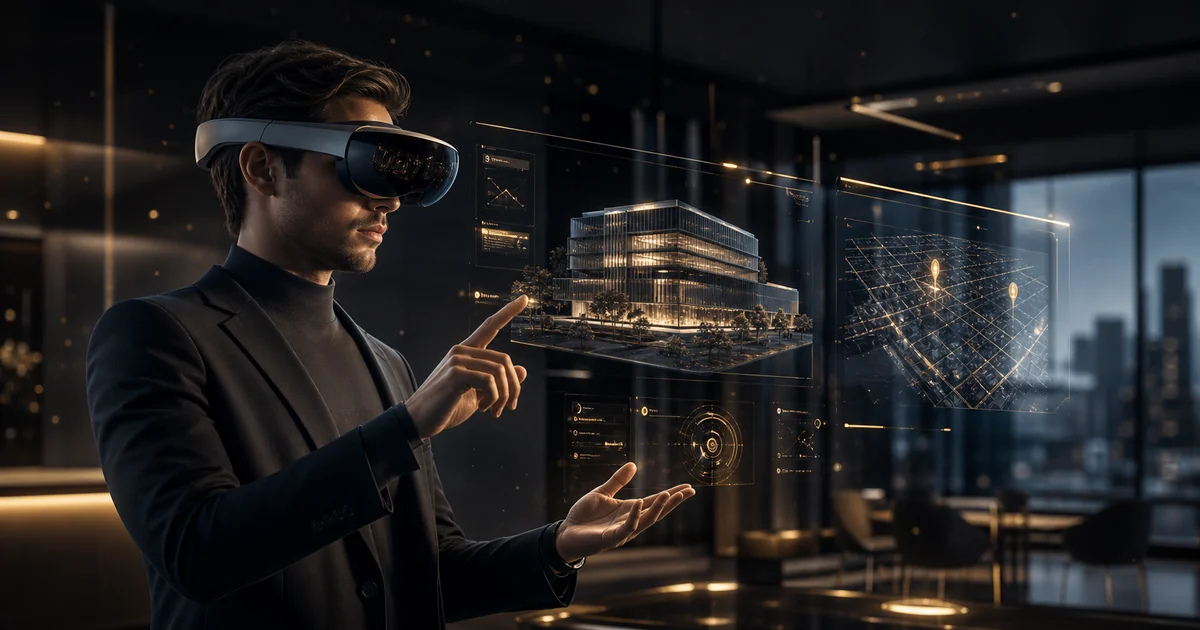
Spatial computing places digital information and interaction in a physical or immersive environment. It is useful when space, scale, embodiment or hands-free context improves the task; it is unnecessary when a clear mobile or web interface works better.
Headsets, phone-based AR, real-time 3D and digital-twin assets are converging. Curiosity is high, but sustainable adoption depends on comfort, accessible alternatives, content maintenance and a workflow that continues after the demonstration. The practical decision is therefore not whether the trend is exciting. It is whether a bounded use case can be delivered with clear ownership, evidence, acceptable cost and a safe fallback.
What the technology actually involves
Experience mode
Choose phone AR, headset mixed reality or fully immersive VR according to environment, duration and user access. Define the permitted data and action explicitly, then enforce the rule in trusted application code.
Spatial interaction
Design gaze, gesture, controller, voice and physical movement with safe, learnable alternatives. Measure latency, quality and correction effort on the devices and environments real users have.
Content pipeline
Optimise 3D assets, instructions and data updates for device limits and ongoing ownership. Document dependencies and a fallback that preserves the most important user outcome during an outage.
Operational integration
Connect identity, progress, assets and support without exposing unnecessary sensor data. Translate that boundary into acceptance tests and an operational view before selecting a platform.
Where it can create business value
1. Training a physical procedure without consuming equipment
This is valuable only when it removes a real constraint in the journey. Connect the experiment to one commercial measure and one user-quality measure so activity cannot masquerade as value.
2. Reviewing design at human scale before construction
This is valuable only when it removes a real constraint in the journey. Make adoption voluntary at first, observe where people correct the system and feed those cases back into design.
3. Guiding field work with contextual overlays
This is valuable only when it removes a real constraint in the journey. Include integration, review and support effort in the business case rather than reporting only the automated step.
4. Presenting products or environments that are difficult to transport
This is valuable only when it removes a real constraint in the journey. Use a time-limited pilot with explicit stop conditions before increasing data access, spend or autonomy.
These examples are starting points, not promised outcomes. Value depends on process volume, data quality, user adoption, integration effort and the cost of exceptions. Link the pilot to one business measure and one quality measure so speed does not hide rework.
Risks and controls to design early
- Motion discomfort, fatigue or physical collision. Review the exposure after material changes to providers, models, data, interfaces or operating context.
- Excluding users who cannot wear or operate the device. Reduce the blast radius through least privilege, staged access and a tested way to stop or reverse the process.
- 3D content becoming stale and expensive to update. Make the failure visible to users and operators instead of silently returning an incomplete result.
- Camera, mapping or biometric-like sensor data retained without need. Review the exposure after material changes to providers, models, data, interfaces or operating context.
Security, privacy, accessibility, employment, intellectual-property and sector obligations vary by context. Use qualified advisers for formal conclusions and keep the technical design capable of enforcing the resulting policy.
A practical implementation roadmap
- Define the first outcome. Begin with training a physical procedure without consuming equipment and state what useful completion means for the affected user.
- Map the enabling system. Document experience mode, spatial interaction, content pipeline, operational integration and the owner of every hand-off.
- Measure the current constraint. Capture time, error, delay, access and support effort before technology changes the route.
- Build a complete but bounded pilot. Include identity, logging, failure handling and a human route around motion discomfort, fatigue or physical collision.
- Test the uncomfortable cases. Exercise excluding users who cannot wear or operate the device; 3D content becoming stale and expensive to update; camera, mapping or biometric-like sensor data retained without need as well as successful use.
- Expand in controlled stages. Increase users, data, authority or capacity separately so a regression has a traceable cause.
- Review the operating model. Decide who owns changes, incidents, supplier coordination and periodic re-evaluation of spatial computing AR VR business.
This sequence aligns with AUZtec's approach to ui ux design, turnkey solutions, mobile apps. Where a conventional API, rules engine or well-designed interface solves the need more reliably, that should remain a valid outcome of discovery.
Questions to ask a technology supplier
- How will the proposed design improve training a physical procedure without consuming equipment for the intended user?
- Which evidence proves that experience mode works with our data and environment?
- How does the system prevent or contain motion discomfort, fatigue or physical collision?
- Who can change spatial interaction, and how is that change reviewed?
- What happens when content pipeline is unavailable, incorrect or incomplete?
- Can we export records, configuration, history and evidence in a usable format?
- Which tests will be rerun after a provider, model, interface or policy change?
- What will integration, support, training and usage cost after the pilot?
Implementation checklist
- Document experience mode and its owner.
- Document spatial interaction and its owner.
- Document content pipeline and its owner.
- Document operational integration and its owner.
- Define measurable success, stop conditions and a manual fallback.
- Validate internal links, source rights, privacy and accessibility requirements.
- Include monitoring, incident response, recovery and supplier exit in the design.
- Re-evaluate after model, provider, data or workflow changes.
Related AUZtec guidance
Continue with digital twins business operations, webgpu business web applications, website accessibility audit checklist. These articles cover adjacent architecture, security and delivery decisions without replacing the specific decision owned by this guide.
Primary references
The decision to make now
Treat spatial computing AR VR business as a product and operating-model choice, not a novelty purchase. Start with a narrow outcome, design the control boundary before increasing autonomy, and keep evidence that allows leaders to compare benefit with total cost and risk.
AUZtec Innovations can combine ui ux design, turnkey solutions, mobile apps into one scoped delivery path. Tell us what you are trying to improve and we will help identify the smallest credible implementation.