Motion Capture and Digital Characters: How Performances Become Animation
Understand motion and performance capture from markers and cameras through solving, retargeting, facial animation and artistic cleanup.
By AUZtec Innovations
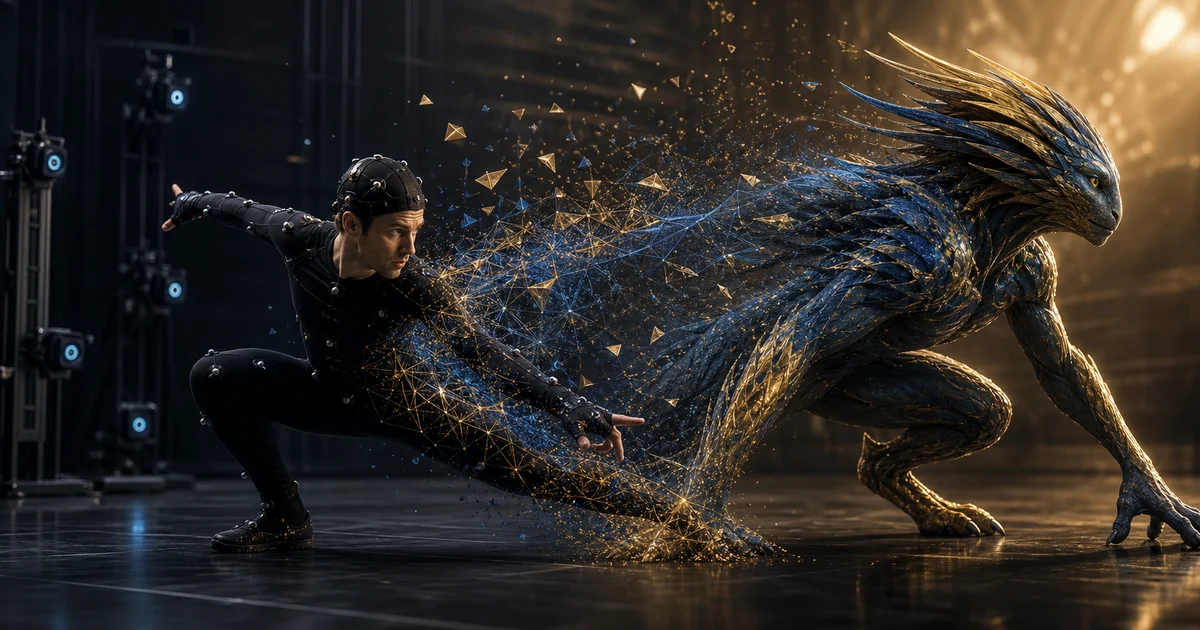
Motion capture records body movement and maps it to a digital skeleton; performance capture may also include face, hands and voice. Software solves tracked observations into animation, which artists retarget, clean and adapt to the character and story.
Real-time engines, accessible sensors and digital-human tools are bringing performance capture beyond blockbuster films into games, training, live events and interactive experiences. Human performance remains the source; technology translates and extends it. The practical decision is therefore not whether the trend is exciting. It is whether a bounded use case can be delivered with clear ownership, evidence, acceptable cost and a safe fallback.
What the technology actually involves
Capture volume
Calibrated cameras or inertial sensors record movement with synchronised time and a known coordinate space. Test it with representative, incomplete and adversarial inputs instead of demonstrating only the ideal path.
Solving
Software estimates joint, body and facial motion while handling occlusion, noise and missing observations. Make the state visible enough that support teams can diagnose a failure without reading model reasoning.
Retargeting
Movement transfers to a character with different proportions, rig controls and physical limits. Keep the interface narrow, versioned and reversible so later technology changes do not rewrite the business process.
Artistic finish
Animators correct contacts, expression, weight and timing so technically captured motion supports the intended performance. Define the permitted data and action explicitly, then enforce the rule in trusted application code.
Where it can create business value
1. Creating believable character movement efficiently
This is valuable only when it removes a real constraint in the journey. Include integration, review and support effort in the business case rather than reporting only the automated step.
2. Driving a live avatar for broadcast or events
This is valuable only when it removes a real constraint in the journey. Use a time-limited pilot with explicit stop conditions before increasing data access, spend or autonomy.
3. Recording training and simulation scenarios
This is valuable only when it removes a real constraint in the journey. Compare outcomes by user group and context so an average improvement does not hide a serious weak path.
4. Capturing reference that animators can refine
This is valuable only when it removes a real constraint in the journey. Treat the result as evidence for a product decision, not as a promise that every similar workflow will behave alike.
These examples are starting points, not promised outcomes. Value depends on process volume, data quality, user adoption, integration effort and the cost of exceptions. Link the pilot to one business measure and one quality measure so speed does not hide rework.
Risks and controls to design early
- Poor calibration or occlusion creating expensive cleanup. Add a negative test and keep the resulting evidence in the release checklist.
- Unclear performer consent and reuse rights. Assign the policy decision to an accountable person and enforce it outside probabilistic model output.
- Treating raw capture as finished animation. Mitigate it with a preventive control, a measurable warning signal and a named incident owner.
- Face or body data retained without an appropriate lifecycle. Add a negative test and keep the resulting evidence in the release checklist.
Security, privacy, accessibility, employment, intellectual-property and sector obligations vary by context. Use qualified advisers for formal conclusions and keep the technical design capable of enforcing the resulting policy.
A practical implementation roadmap
- Define the first outcome. Begin with creating believable character movement efficiently and state what useful completion means for the affected user.
- Map the enabling system. Document capture volume, solving, retargeting, artistic finish and the owner of every hand-off.
- Measure the current constraint. Capture time, error, delay, access and support effort before technology changes the route.
- Build a complete but bounded pilot. Include identity, logging, failure handling and a human route around poor calibration or occlusion creating expensive cleanup.
- Test the uncomfortable cases. Exercise unclear performer consent and reuse rights; treating raw capture as finished animation; face or body data retained without an appropriate lifecycle as well as successful use.
- Expand in controlled stages. Increase users, data, authority or capacity separately so a regression has a traceable cause.
- Review the operating model. Decide who owns changes, incidents, supplier coordination and periodic re-evaluation of how motion capture digital characters work.
This sequence aligns with AUZtec's approach to turnkey solutions, ui ux design, cloud devops. Where a conventional API, rules engine or well-designed interface solves the need more reliably, that should remain a valid outcome of discovery.
Questions to ask a technology supplier
- How will the proposed design improve creating believable character movement efficiently for the intended user?
- Which evidence proves that capture volume works with our data and environment?
- How does the system prevent or contain poor calibration or occlusion creating expensive cleanup?
- Who can change solving, and how is that change reviewed?
- What happens when retargeting is unavailable, incorrect or incomplete?
- Can we export records, configuration, history and evidence in a usable format?
- Which tests will be rerun after a provider, model, interface or policy change?
- What will integration, support, training and usage cost after the pilot?
Implementation checklist
- Document capture volume and its owner.
- Document solving and its owner.
- Document retargeting and its owner.
- Document artistic finish and its owner.
- Define measurable success, stop conditions and a manual fallback.
- Validate internal links, source rights, privacy and accessibility requirements.
- Include monitoring, incident response, recovery and supplier exit in the design.
- Re-evaluate after model, provider, data or workflow changes.
Related AUZtec guidance
Continue with how cgi works in movies, digital humans ai customer experience, virtual production led walls filmmaking. These articles cover adjacent architecture, security and delivery decisions without replacing the specific decision owned by this guide.
Primary references
The decision to make now
Treat how motion capture digital characters work as a product and operating-model choice, not a novelty purchase. Start with a narrow outcome, design the control boundary before increasing autonomy, and keep evidence that allows leaders to compare benefit with total cost and risk.
AUZtec Innovations can combine turnkey solutions, ui ux design, cloud devops into one scoped delivery path. Tell us what you are trying to improve and we will help identify the smallest credible implementation.