Robot-Ready Factory Digital Twins: Simulating Automation Before It Goes Live
Use factory digital twins to test robot routes, control logic and throughput before deployment without mistaking simulation results for safety proof.
By AUZtec Innovations
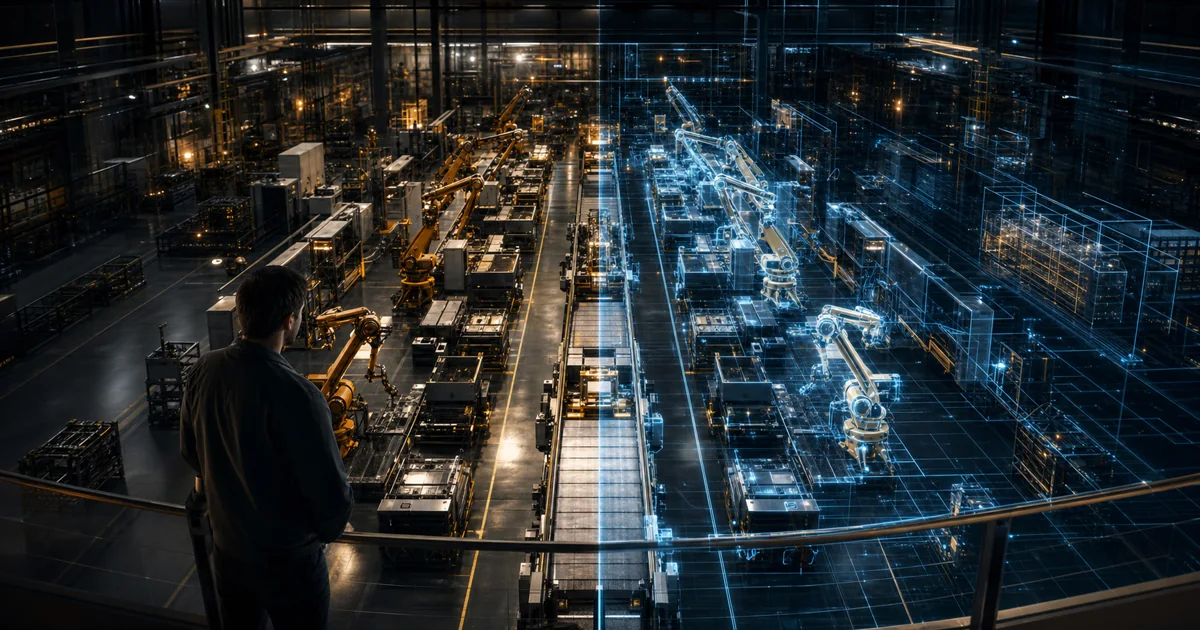
A robot-ready factory digital twin is a simulation connected closely enough to real geometry, equipment, control logic and operational data to support robotics decisions. It can expose route conflicts, unreachable objects and throughput constraints before hardware is installed.
The twin is useful when it answers a defined decision. It becomes an expensive animation when fidelity, ownership and validation are unclear.
What makes a twin robot-ready
General facility visualisation may show buildings and assets. Robotics requires more:
- accurate collision geometry and coordinate systems;
- robot kinematics, payload and tool characteristics;
- sensor placement and relevant environmental effects;
- conveyor, door, lift and safety-zone behaviour;
- material flow and process timing;
- interfaces to robot and operations software;
- version control for the physical layout and simulation.
NVIDIA has described manufacturers using Omniverse digital twins to design factories and train physical-AI systems. The important pattern is the combination of simulation, synthetic data and operational integration—not the assumption that one platform automatically reproduces reality.
Begin with one decision
Good first questions include:
- Can a robot reach every required pick position?
- Where will two routes compete for the same space?
- What throughput is possible under realistic arrival variation?
- Where should sensors be placed?
- How does a failure affect downstream work?
Set acceptance thresholds and the evidence required to trust the answer. Avoid modelling machinery that does not affect the chosen decision.
Build a governed data pipeline
Geometry may come from CAD, scans and site surveys. Behaviour comes from controller specifications, timing studies and operational history. Production status may arrive through PLC, MES, WMS or IoT systems.
Record source, date, units, coordinate frame and confidence. Transform data through a repeatable pipeline rather than manual edits hidden inside the scene. An industrial integration should isolate legacy protocols from the simulation and production applications.
Calibrate against the physical process
Compare simulated cycle time, queue length, downtime and route behaviour with observations from the real site. Investigate the difference instead of tuning values until the dashboard looks right.
Validation should be repeated after layout, payload, firmware or process changes. Show users the twin version and freshness; a precise-looking obsolete model is dangerous.
Use synthetic data carefully
Simulation can generate labelled images and sensor streams for perception models, especially for rare conditions. Vary lighting, camera position, materials, clutter and occlusion. Then test on untouched real-world data.
Synthetic performance does not demonstrate production safety. Domain gaps can be subtle: reflections, worn surfaces, unexpected packaging or human behaviour.
Read our physical AI safety guide for the independent controls needed outside the learned system.
Architecture for a maintainable twin
Separate four concerns:
- Authoritative asset data for equipment, versions and location.
- Simulation models for geometry, physics and behaviour.
- Operational event streams for current state and history.
- Decision applications for planning, training or monitoring.
Use stable identifiers across them. Do not make the 3D scene the only place where business meaning exists. A turnkey platform can provide role-based workflows and evidence around the specialist simulation engine.
Make performance visible
Large scenes, high-frequency sensors and photorealistic rendering are computationally expensive. Allocate fidelity to the decision: a path-planning study may not need cinema-quality materials; a camera-placement test may.
Measure simulation duration, data freshness and cost per scenario. Cache immutable assets, stream only necessary signals and keep heavy work away from operational control networks.
A sensible pilot
Select one cell or route. Capture the current state, build minimum viable fidelity and validate against measured operation. Run alternative layouts and identify a decision that changes because of the result. Then test that change at controlled physical scale.
Only expand when the pilot demonstrates repeatable decision value and an affordable maintenance process. Our broader digital twin guide covers ownership and ROI, while edge AI and IoT covers the live data layer.
If you are evaluating factory simulation, contact AUZtec for a discovery focused on the smallest model that can support a real operational decision.